
Your Local Non-QM Mortgage
Specialist
States Licensed in Pensylvania, Florida and Iowa
Home and investment property loans for self-employed borrowers,
real estate investors, and anyone the big banks turn away.
Personalized Non-QM Experience
Robert Love specializes in Non-QM lending, the loan products designed for borrowers who do not fit the conventional mold. Whether you are self-employed, paid through 1099s, growing a real estate portfolio, or rebuilding after a past credit event, we shop multiple wholesale lenders to find the program and rate that fit your actual financial picture.
Tax returns that do not tell your full story should never cost you the property you want. We qualify borrowers using bank statements, rental income, assets, and other common-sense documentation, all backed by wholesale pricing and technology that keeps the process fast and transparent.
Trust a specialist who focuses on the loans other lenders avoid. Let us help you close on your next home or investment property.
The Non-QM Loan Process
Get Pre-Qualified Talk with a
Non-QM specialist
We match you to the right program and show you what you qualify for, with no tax returns required for many of our products.
Find Your Property
Whether it is your next home or an investment property, work with a trusted real estate agent to find the right fit. DSCR and investor purchases are welcome.
Submit Your Application
Complete your application and let us guide you through underwriting. We handle the heavy lifting and keep you updated all the way to closing.
Don't take my word for it
Non-QM Programs
Mortgage solutions built for self-employed borrowers, investors, and complex financial situations, right here in Panama City Beach, Florida.
Loan Options That Actually Fit You
Our experienced mortgage advisors will walk you through the best mortgage loan program that will fit your specific scenario.
Bank Statement Loans
DSCR Loans (Investor Loans)
Equity Xcellarator Loan
Reverse Mortgage
Frequently Asked Questions
What is a Non-QM loan?
Non-QM stands for Non-Qualified Mortgage. These loans do not follow the strict documentation rules of conventional mortgages, which makes them a fit for self-employed borrowers, investors, and others with non-traditional income. Non-QM does not mean high risk; it means flexible qualification.
Can I get a mortgage if I'm self-employed?
Yes. Many of our self-employed clients qualify using bank statements or a profit and loss statement instead of tax returns, so business write-offs do not work against you.
Can I qualify using my bank statements instead of tax returns?
For most of our bank statement programs, yes. We review 12 to 24 months of deposits to calculate your qualifying income. No tax returns or W-2s needed.
Can I get a loan based on my rental property's income?
Yes, through a DSCR loan. We qualify the loan based on whether the property's rent covers the payment, so your personal income often is not part of the equation.
Can I get a mortgage after a recent bankruptcy or foreclosure?
Often, yes. Several Non-QM programs allow financing with little or no waiting period after a credit event, while conventional loans may require years.
Are Non-QM rates higher than conventional rates?
Non-QM rates are typically a bit higher because the qualification is more flexible. For many borrowers, access to financing now outweighs waiting, and we shop multiple lenders to secure the most competitive pricing available for your profile.
How much down payment do I need for a Non-QM loan?
Down payment requirements vary by program and credit profile and are generally higher than minimum conventional options. We will review your scenario and show you the exact figure during your qualification review.
Can foreign nationals buy property in the US?
Yes. Our foreign national programs help non-US citizens purchase a home or investment property, often without US credit or income documentation.
Can I refinance an investment property or take cash out?
Yes. We offer rate-and-term and cash-out refinancing on investment and non-owner-occupied properties through our DSCR and investor programs.
How long does a Non-QM loan take to close?
Timelines vary, but many Non-QM loans close within a few weeks. Because we use wholesale lenders and streamlined documentation, the process is often faster than borrowers expect.
Most Recent Blog Updates
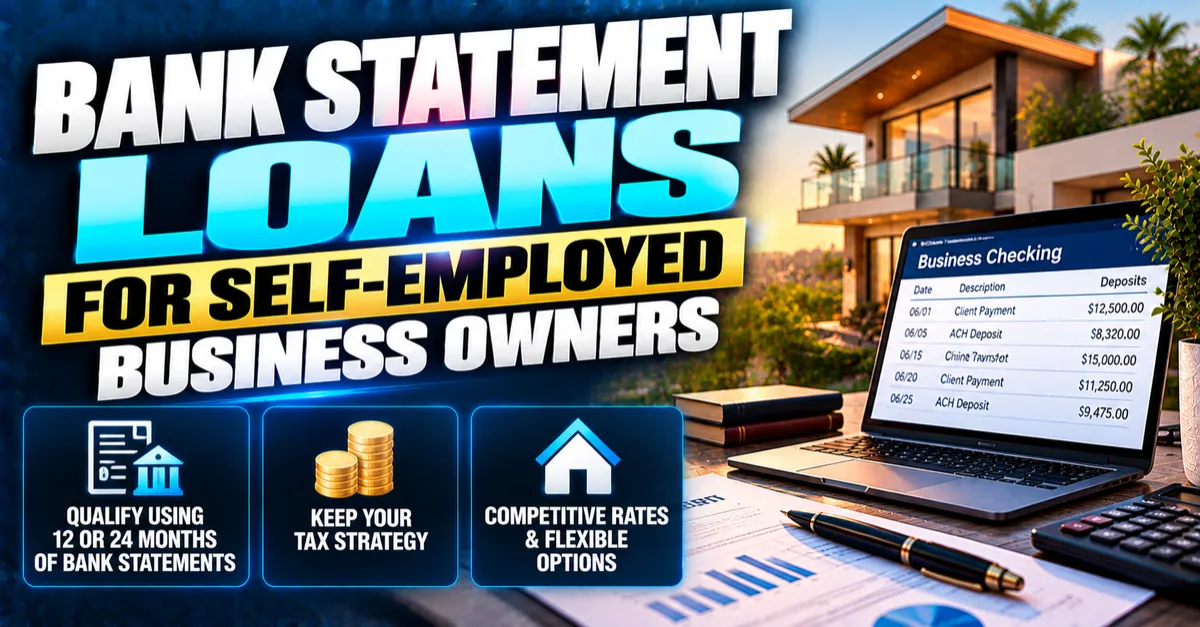
Bank Statement Loans Let Self-Employed Borrowers Qualify on Real Income Without Sacrificing Tax Strategy
The Loan That Finally Solves the Self-Employed Mortgage Problem
If you are a self-employed business owner who has been frustrated trying to qualify for a mortgage because your tax returns show a fraction of what you actually earn Robert Love has a direct message for you. The bank statement loan exists specifically for your situation and it changes everything about how your income gets evaluated.
The Problem With Traditional Mortgage Qualification for Self-Employed Borrowers
Traditional mortgage qualification runs on tax returns. For W-2 employees that works reasonably well because the income on the return reflects what they actually earn. For self-employed borrowers it produces a number that almost always dramatically understates real earnings.
The reason is straightforward. Self-employed business owners legitimately write off business expenses to reduce taxable income. Every deduction that makes sense from a tax strategy standpoint reduces the income figure a traditional lender uses to qualify the borrower. Strong gross earnings, smart tax planning, and a mortgage denial can coexist perfectly without any of them being wrong.
The tax strategy is working exactly as intended. The qualification method is the problem.
How the Bank Statement Loan Actually Works
Instead of qualifying based on tax returns the bank statement loan uses twelve or twenty-four months of business or personal bank statement deposits to calculate income. The deposits tell the real story of what money is actually flowing through the business rather than what remains after every legitimate deduction has been applied.
That means you can keep maximizing your tax strategy and lowering your tax bill while simultaneously qualifying for the home or investment property you actually want. The two goals that traditional lending forces you to choose between are no longer in conflict with each other.
Who This Program Is Built For
Entrepreneurs running their own businesses. Real estate agents whose income varies by production rather than arriving on a salary schedule. Consultants and freelancers whose income documentation does not fit the W-2 mold. Anyone who runs their own show and has watched a traditional lender look at the tax return and stop the conversation there.
Bank statement loans typically come with competitive rates, flexible down payment options, and the ability to close in the borrower's personal name or through an entity depending on what best serves the situation and investing strategy.
If traditional lenders have told you no this may be the loan that finally says yes.
What the Conversation With Robert Love Looks Like
Text, call, or DM Robert Love anytime at 515-805-8870 to find out whether a bank statement loan is the right fit for your specific situation. Follow along for more strategies that help self-employed borrowers win.
Sources
ConsumerFinancialProtectionBureau.gov
MortgageNewsDaily.com
NationalMortgageProfessional.com
FannieMae.com
Investopedia.com

Mortgage Calculator
Estimate your monthly payment and see how a Non-QM loan could
work for your home or investment property.
| Year | Interest | Principal | Balance |
|---|

Quick Links
About Us
Blogs
Programs
